

Interview Article 2: My passport has stamps from only two countries — Uganda and Japan.” ~ Who Is the Representative Director of Smileyearth with Such Deep Ties to Uganda?~
Interview Article 2: My passport has stamps from only two countries — Uganda and Japan.” ~ Who Is the Representative Director of Smileyearth with Such Deep Ties to Uganda?~
※In November 2024, Kojima, Araki and Fukuoka conducted an interview with Mr. Tatsumasa Oku, the representative director of Smileyearth Corporation.
Kojima
Could you tell us when your own connection with Africa first began?
And we were intrigued to learn that you once competed in the Hakone Ekiden*—we’d love to hear more about your experiences before joining Smileyearth.
*The Hakone Ekiden is a historic two‑day, 217‑km university road relay race, first held in 1920, and run every January between Tokyo and Hakone.
Finding out I was the son of a towel maker was a huge shock.” — Childhood Years
Mr. Oku
This overlaps with what I mentioned earlier (in Interview Article 1), but around 1998, the Kasii River flowing through Izumisano was officially announced as the most polluted river in Japan.
-
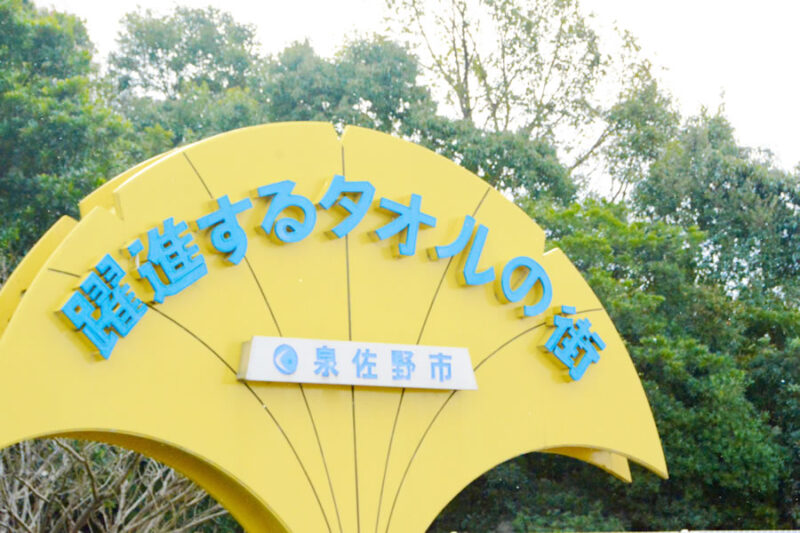
※Photo ① (City sign: Izumisano City, A Thriving Towel Production Area)
Izumisano was once called ”Izumi Province,” and “Izumi” means “a peaceful spring”—a calm and pure water source.
Thanks to its abundant water resources, the towel industry flourished here for generations. But the very wastewater produced in the process of making local specialty towels ended up polluting the river until it became the dirtiest in Japan. (It still hurts to say that.)
I was in the fifth grade — when this happened. Our school organized an outdoor learning project to study why our local river had become so polluted.
I loved nature, so I researched the issue earnestly and honestly. And I discovered that a major cause was wastewater from towel manufacturers. The shock I felt then is something I still remember vividly.
I felt very guilty at the time. Many children in Izumisano were sons and daughters of towel manufacturer. I’m sure I wasn’t the only one who felt embarrassed. The more I researched, the more I wanted to avoid talking about it — even pretend I hadn’t seen the results. I never imagined inheriting the family towel business.
No interest in the family business — Running was my passion
From there to the Hakone Ekiden… and then, unexpectedly, Uganda!!?
Mr. Oku
I had no intention of taking over the family towel business. Instead, during my student years, I devoted myself to running — something I had always been good at. While my father was traveling to Uganda, and starting his new venture in organic cotton, I was in high school. That was when Smileyearth was born.
I left home, entered Kokugakuin University, joined the track and field team, and pursued my dream of competing in the Hakone Ekiden.
But in my second year, I hit a slump. No matter how much I ran, my record wouldn’t improve” In frustration I told my father, “I’ll quit and come home. I’ll take over the business.”
But he shot back: “What are you talking about? You think someone who can’t even run Hakone can take over our family business?” He turned me away immediately.
After that exchange, I returned to the team and kept running. Looking back, that setback forced me to reflect, and it ultimately became a meaningful turning point.
-
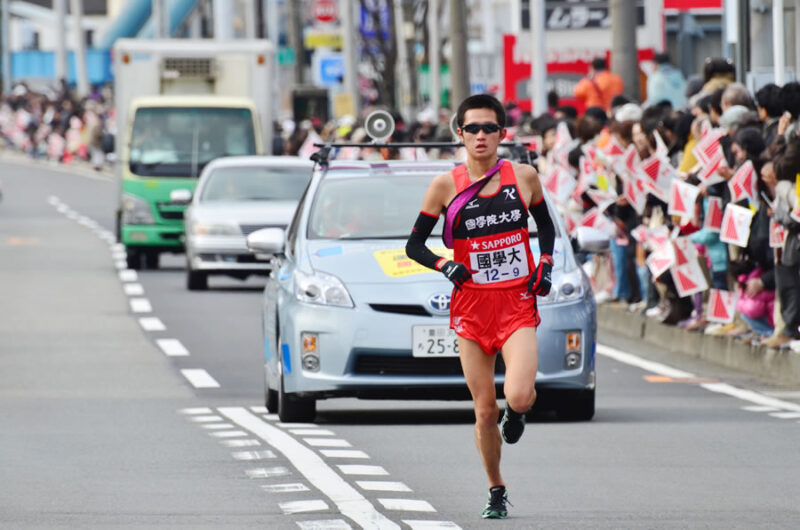
※Photo ② (Mr. Oku running in the Hakone Ekiden)
I eventually achieved my goal of running the Hakone Ekiden, even helping my university secure a seeded position for the first time in its history. I had already received a job offer as an athlete, when my father suddenly said:
“Hakone is over. Are you ready to come home now? Your mindset must have changed after running Hakone.”
We had a huge argument. I had already accepted a job – why would he say this now? But deep down, after achieving such a big goal, I felt calm. I could finally reflect on myself clearly.
There was also a sense of responsibility:
A family that has passed down its craft for generations… *… someday, I’ll have to return and carry on that legacy.
*The towel business was founded by the first generation (Mr. Oku’s grandfather), and during the second generation (Mr. Oku’s father), the company was renamed Smileyearth.
And while I was training for the Hakone Ekiden, I also watched from the sidelines as my father was trying to transition from the towel-making method I’d known from my childhood to an environmentally friendly towel-making. At the end of my senior year, after experiencing many things through the Hakone Ekiden, at my father’s suggestion, I went to Uganda alone for the first time. It was my graduation trip.
Mr. Kashiwada — whom I mentioned earlier — picked me up at the airport and welcomed me into his home.
He spent hours telling me about Uganda, why he was committed to organic cotton, and how he had been connecting bridges between Uganda and Japan. He talked late into the night, all the way until dawn.
Listening to him, I felt his passion firsthand. And I realized clearly that what he was saying aligned perfectly with what my father had been striving to do through Smileyearth.
Hearing it from someone else helped my father’s vision finally make sense to me. When I visited the national parks, the wildlife sightings were so unbelievable — to this day, after dozens of trips to Uganda, that first visit remains number one in my memory. Because of my encounter with Mr. Kashiwada, I returned to Japan with a newfound affection for Uganda.
-
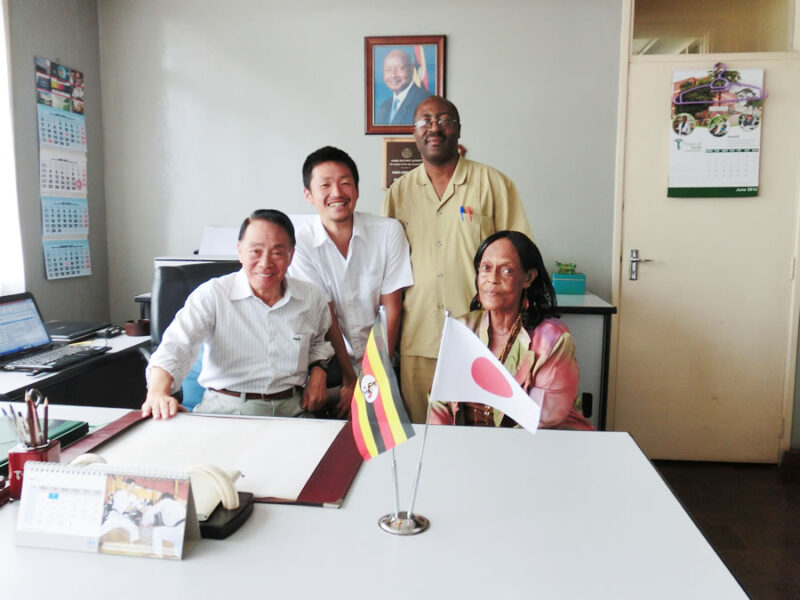
Photo ③: Photo of Mr. Kashiwada and Mr. Oku
After visiting Uganda, I gained a renewed appreciation for the magnitude of what my father was trying to accomplish. It also made me feel, genuinely, that taking over Smileyearth as my next step might be the right path for me. So, after graduating from university, I returned to Izumisano.
At that time, Smileyearth had completely halted traditional towel production and was conducting research on how to make towels in a way that prioritized the natural environment and ecosystems. I spent about two years gaining experience at another company – a spinning company while learning about my father’s approach and the work he had begun.”
Our conflicts helped us find clarity — and shape our vision.
Kojima
After returning to Izumisano, you began building Smileyearth together with your father. How did the two of you work together?
Mr. Oku
My father and I are very similar — which means we clash often. For example, When I proposed accepting the factory tours, my father strongly opposed it.
In 2018, Smileyearth received the Monodzukuri Nippon Grand Award from the Minister of Economy, Trade and Industry, a major national honor.
Up to that point, we had simply been doing what we believed was best. Receiving that recognition made us ask ourselves, “Where do we go from here?” I felt that sharing our work more openly through factory tours would help others understand what we value.
My father, however, came from a generation where factories were treasure troves of trade secrets, closed to all but craftspeople. We debated everything — whether to charge admission, how to prevent technical leakage — until we reached mutual understanding.
It took quite some time before we could start offering factory tours, but now we host more and more participants each year. What makes us happiest is when visitors understand our philosophy and principles that we value and purchase our products with confidence.
-
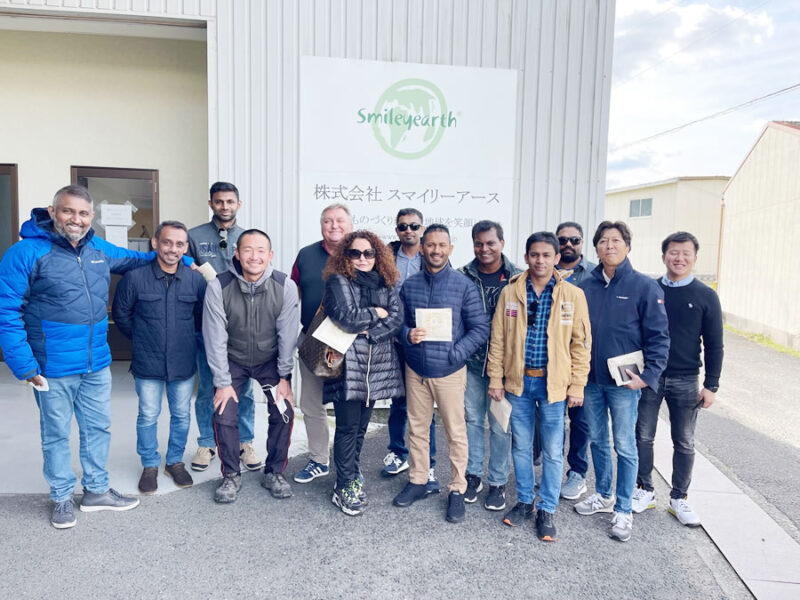
※Photo ④: Scene of receiving the inspection delegation from Uganda
My father and I often discuss fundamental questions:
- “What do we really want to achieve at Smileyearth?”
- “What is it that you truly want to express?”
Whether we’re hiking together or traveling in Uganda, we talk constantly. I’ve learned so much through these conversations.
Even the way we think about selling towels changes depending on our mindset:
- Are we happy as long as people just buy our towels?
- Or do we want them to understand and share our philosophy before purchasing?
- That difference alone can completely change how we approach our customers and the products we create.
Kojima
Conclude Interview Article 2, could you tell us what your father means to you?”
Mr. Oku
For my father, it’s definitely “respect.” And while saying I want to surpass him might sound inappropriate, I do have the desire to become someone who can properly take over his role. I think it’s truly amazing that my father transformed our family business into and environmentally responsible towel making under the name of Smileyearth.
Because my father had such a significant influence, I strive to follow in his footsteps and live up to his example. I also want to play a role in passing on the legacy to the next generation.
Just like in a relay — if one runner falters, the next must work even harder to make up for the loss, but this is very difficult. When it’s your turn, you fulfill your role properly—that’s what makes a great Ekiden.
I have children of my own. I want to pass the tasuki* to them in a good way. I believe the next generation will have their own Smileyearth. It might take a form that I can’t even imagine, or it might come to an end. I don’t know what will happen, but I want to fulfill my role as the best I can and pass it on to the next generation.
*In an ekiden, the tasuki is the cloth sash that works as the relay “baton.”
Mr. Oku who once felt embarrassed to be the son of a towel manufacturer, shared his experiences running in the Hakone Ekiden, his life-changing encounters in Uganda, and the emotional journey that shaped who he is today.
In the next article, we explore in more detail how he has engaged with Uganda and what that relationship has meant to him.”
- PREX Kojima, Araki, Hazama, Fukuoka
- Smileyearth Corporation
- 2025-05-07

