Why a Towel Manufacturer Stopped Selling Towels for Ten Years
When my father decided to start making towels using organic cotton from Uganda, he didn’t intend to continue using the same production system as before, because he was working with materials that had been carefully cultivated with a focus on protecting the natural environment.
Around the 2000s, when towel production in Izumisano peaked, the water quality of the Kashii River, which flows through Izumisano, became the worst in Japan. Towel manufacturing uses large amounts of water and relies heavily on petroleum derived chemicals. Wastewater from local factories had severely impacted the river’s ecosystem. This was something my father wanted to change.
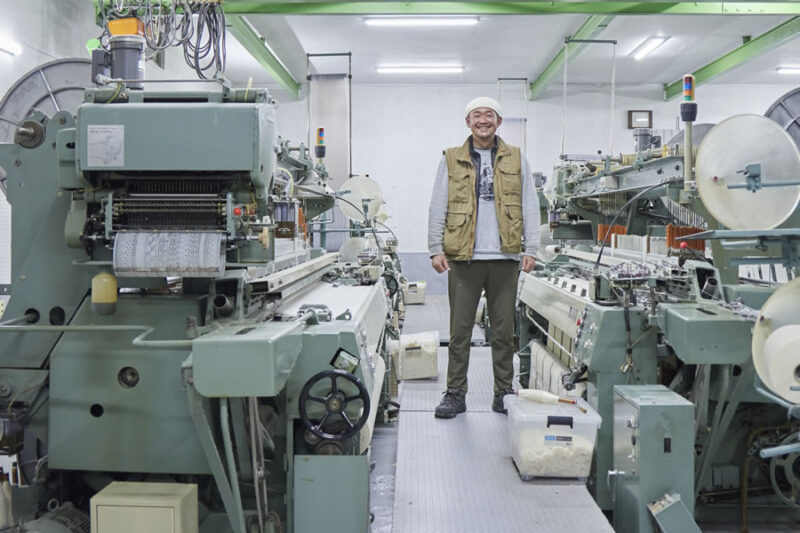
After encountering Uganda’s organic cotton, he began building a fully integrated production system within our own factory — a major shift for an industry traditionally based on divided processes among several companies. Because many towel companies were closing due to competition from China, he was able to acquire machinery and equipment from them. It took five years to build a production system that allowed Smiley Earth to manufacture a towel entirely in-house.
But the real challenge came afterward. Developing the technology to make towels with minimal environmental impact took ten years. Committed to doing things properly, my father stopped selling towels entirely to focus on research and development.
He believed, “If we’re not satisfied with the towels ourselves, we shouldn’t sell them.” As a result, the company did not sell a single towel for ten years.
During that period, with support from Mr. Kashiwada, he imported high-quality organic cotton from Uganda and sold it in Japan to keep the business going. Smileyearth was officially founded in 2008, so its very first activity was actually the domestic sale of Uganda’s organic cotton.
While my father devoted himself to developing low‑impact towel‑making methods, I don’t think he imagined the process would end up taking a full decade! (laughs)
Kojima
Hearing that Smileyearth spent ten years developing environmentally responsible towel making techniques truly amazed us. “I never imagined it would take 10 years,” he said with a laugh, and we were completely engrossed in his story as he continued to explain things with such ease. It still feels almost unbelievable that someone could sustain such a commitment for so long, with no guarantee that they would find the solution they were looking for.
For details on Smileyearth’s eco-friendly towel production, please visit the Smileyearth website.
https://smileyearth.co.jp/nature-towel-factory/ (in Japanese)
https://smileyearth.co.jp/towel-factory/ (in Japanese)
In the next article, we will delve into the relationship between the third-generation representative director , Mr. Oku and Uganda, as well as the specifics of doing business in Uganda.