

Interview Article 3: I just don’t ‘trust’ —that’s exactly why I work with them”
~Securing High Quality Cotton in Uganda~
※In November 2024, Kojima, Araki and Fukuoka conducted an interview with Mr. Tatsumasa Oku, the representative director of Smileyearth Corporation.
What I want, more than anything, is Uganda’s finest cotton
Kojima
Smileyearth currently uses 100% organic cotton from Uganda. We often hear that while trust is critical in international partnerships, building it can be difficult. How have you developed trust with your partners in Uganda?
Mr.Oku
Problems most often arise during transport—quantities mysteriously “shrink,” or sloppy handling causes the quality to drop. But I don’t want to blame Uganda for that. So I go there myself to buy cotton. I load the cotton myself and arrange the transport.
As for “trust” … I actually start from not trusting in the sense that I don’t just hand things off. Once the farmers have grown high quality cotton, the rest is my responsibility.
Farmers care for their cotton every day so it can grow well. Without them, I would never get the cotton I want. So, the moment the cotton is harvested, I’m deeply grateful to the farmers.
Cotton isn’t an all season crop, so many seasonal workers are involved. Rather than outsourcing everything, I roll up my sleeves and work with them—including loading. And I mean literally with them.
I’ve even worked under the same conditions as seasonal workers for a full month—same call time, same dismissal time. It wasn’t easy.
Just because I’m a foreigner, people assume I have money; There were times when people tried to take my money, and we’d end up getting into arguments like, ‘What do you think you’re doing?’”
Kojima
You actually get into arguments? I know it’s not fair to lump all “Japanese” together, but generally speaking, people tend to avoid conflict and prefer to keep things amicable.
Mr. Oku
I’m not saying people should go around picking fights, but I do believe it’s better to face problems head on rather than avoid them. Of course, it depends on the situation, and it’s not like I get into arguments every time. But if you don’t speak up about what needs to be said, nothing will move forward.
In business, no one is above or below anyone else — the relationship is always equal.
Seasonal workers usually move on to other places after two or three years, but those I worked alongside back then have become true friends.
I think relationships that grow in that way are incredibly important.
-
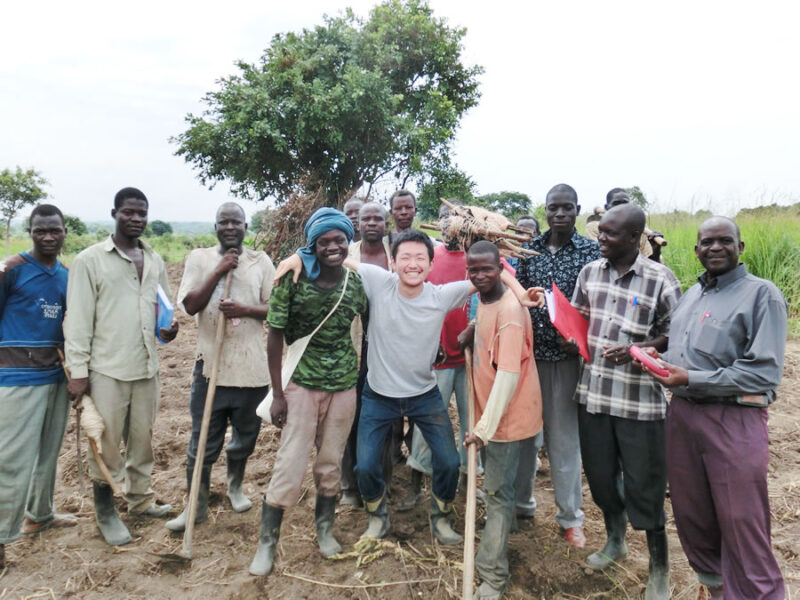
Photo ① Ugandan farmers and Mr. Oku
Another thing I value is respect.
Farmers know a lot. I tell them, “You’re my teacher.”
When you say that sincerely, they speak with confidence. And when people speak, they take responsibility for their words—so they approach their work with a high level of awareness, striving to maintain the quality of the cotton they cultivate.
Building a relationship where we can be completely honest with each other is really important. With climate change affecting production, the quality of cotton now varies from year to year. If I hadn’t gone there myself, I’m pretty sure they would have sold me low‑quality cotton without saying a word.”
“We only sell what we have.” — I won’t put stress on Ugandan farmers.
People say business risk is high in Africa. That’s why you must not rush to sell. I recognize the risks—and then think carefully about my role.
My stance with customers in Japan is:
“We only sell what we have. There will be times we run out; if you need it, please buy when we have stock.”
If someone demands a certain volume without notice, it could undermine our relationship with Ugandan farmers. On the other hand, being told “We have cotton” when that’s not true is just as damaging—I’ve learned that the hard way.
So I tell them,
“If this year’s cotton isn’t good, that’s fine. I’ll come back when it is.”
That way, farmers understand:
“Oku gets our situation—there’s no need to push beyond our limits.”
Approaching it this way is why we’ve been able to work together for so long.
Cotton depends on the weather. Farmers can’t produce high quality cotton unless conditions align. If I ignore those realities and demand to supply regardless, I’d be forcing them into impossible choices—and I refuse to do that.
In the end, what matters most to farmers is the purchase price.
Prices fluctuate, so some will mix part of the cotton back into the soil or burn it for fertilizer, reducing volume to raise the market price.
That’s why I focus on presenting the price and terms we both accept.
And when I say I’ll buy, I buy properly. We have a large warehouse, so we can purchase and store a substantial volume.
In fact, securing that warehouse was also part of committing to Uganda for the long term.
Important Lessons Learned from Ugandan Farmers
Mr. Oku
Working with Ugandan farmers for years, there was a question I couldn’t shake—even though I didn’t have a clear answer. One day I asked:
“In this day and age, there are easier ways to farm. Why continue growing organic cotton—or organic vegetables?”
One farmer friend said, “Because organic is good for the environment.”
That’s true, but I was looking for something deeper.
So I asked his wife—the one who always kindly prepares a quick lunch for us in the fields. Her answer was “life.”
“This organic way of doing things isn’t something we invented. It’s been passed down for generations. We simply continue practices that honor our own lives, the life of nature, and the ecosystems around us.”
That, to me, is the answer to what “organic” really means. Simple words, yet they carry profound weight. When something is truly important, you realize you must protect it.
It isn’t just “organic”—it’s about facing life. A way of living aligned with life.
To pass life safely, we avoid using anything unknown and we repeat the traditional methods passed down from our ancestors. That’s where safety and peace of mind are born.
Hearing that made everything click—what we’ve been doing and where we want to go. Smileyearth’s challenge to “make towels without burdening the environment” wasn’t the goal in itself. At a deeper level, we’ve been striving to realize what we truly wanted: to return to what matters most—our safety, reassurance, and the continuity of life.
We are a towel manufacturer. Many lives are involved in the production of towels. I realized that my father and I had been doing something like checking our answers to confront that issue.
Her words reached the deepest part of me. I realized I’d still been operating too much on the surface. It made me reflect and rethink—a recent experience, but a truly shocking one for me.
In the end, the farmers and we are looking at the same thing and cherishing the same value: life.
We must face that value honestly and keep passing it to the next generation.
By engaging with Uganda, that’s what I’ve learned.
And in learning together, we forged human connections too.
Wanting to remain friends who learn from each other, we kept moving—and that ultimately led to the friendship city relationship between Izumisano, Osaka, and Gulu, Uganda (concluded in 2017), and helped expand goodwill at a national level as well.
Kojima
Hearing how you’ve built relationships in Uganda and how Smileyearth’s challenge is fundamentally about facing life and passing it on to the next generation—these may sound simple in words, but the weight behind them is immense.
To close, could you share what you’re feeling now and how you see the future of our world?
How I’m thinking about the world ahead
Mr. Oku
Regarding the SDGs, I feel strongly that we must treat them not as a temporary trend
but as a responsibility—to carry ‘life’ forward to the next generation.”
Given the many issues we face today, this is exactly the time to revisit and re‑examine what we’ve been doing. I don’t know whether the Earth has a “heart,” but it’s obvious human activity is altering our planet.
We all know humans aren’t the only ones living on earth.
If we truly face our actions—if we begin to think carefully—our approach to those around us will change, and so will our sense of value. I believe that shift will bring positive change for everyone—and for the Earth.
The SDGs are important. But they shouldn’t be forced on people.
What matters is whether we can embrace them with a sense of conviction.
Without that, it’s hard to sustain the effort.
I’ve always valued that sense of conviction.
What we’ve built at Smileyearth is the accumulation of steps we believed in.
When we were founded in 2008, we weren’t aiming for our current state from day one. The SDGs weren’t the goal. We simply kept challenging ourselves in the direction we felt was right—and arrived where we are now.
That stance won’t change.
Be ever modest, and never negligent.
That concludes the interview.
From the origin of Smileyearth, to the challenges they’ve faced, to the story of the third-generation representative director, and much more.
There was far more than we could fit into a single article, but we’ve gathered here the parts we most wanted to share through PREX.
Smileyearth will keep contemplating the essence of monozukuri—of making things.
Thank you for reading this far.
We would be delighted if Smileyearth’s wonderful initiatives could reach as many people as possible.
We’re also publishing reflections from the PREX staff who attended the interview—please take a look if you’re interested.
- 2025-05-07

