

Category
Schedule
March, 2022
Target
For International Students
Participants
PGN members and parties who have cooperated with our training projects.
Contents
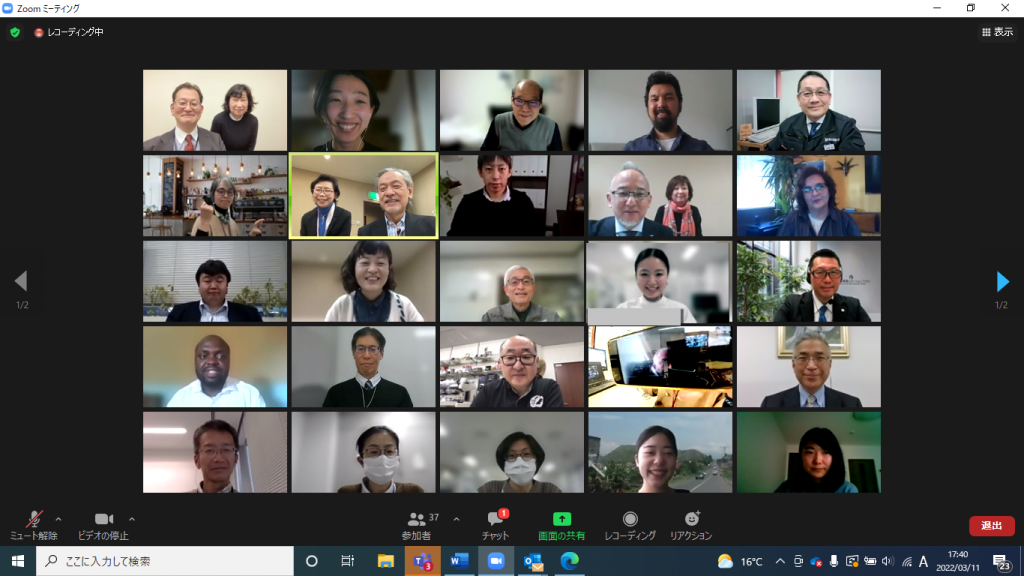
PREX has held the re-union forum utilizing IT app. Even we can not meet face-to-face, we can meet again.
Contents of this Forum is introduced in the article.
Schedule
March, 2022
Persons in Charge
PREX Follow-up Team
Click this photo to check the image video of PREX Global Network Forum
PREX has trained more than 18,600 people in 152 countries since its launch. In addition, we have established alumni associations in 14 regions. Those alumni associations were for participants who participated in courses in Japan. We also maintain relationships with them through follow-up programs.
In April 2019, we reorganized the alumni association’s framework into the PREX Global Network (PGN). This PREX Global Network is not divided by participants’ countries. Instead, the new framework positions all course participants conducted in Japan to date as members. And it is aiming to create a network that transcends countries.
We had planned to hold an event in Japan to commemorate the 30th anniversary of PREX in 2020. But due to the COVID-19 pandemic, it was not possible to invite PGN members from abroad to Japan.
Hence we decided to change its style and in March 2022, we held a Zoom-based exchange forum between PGN members and parties who have cooperated with our training projects.
Six trainees spoke about what they learned in Japan, the impacts of COVID-19 in their countries, and other current matters.
The facilitators were lecturers who cooperate with our training projects. At the forum, they facilitated exchanges of opinions and ideas between Japanese participants and trainees. Discussion is based on the three themes, regional revitalization and industrial development, corporate management and kaizen, and overseas trade and investment.
Participants presented what they had learned through the training, tips from the training they had used to rebuild their businesses—which COVID-19 heavily impacted—and how the industries in their respective countries are overcoming difficult conditions to re-emerge stronger.
This article will introduce some comments from each of the trainees.
■ Facilitators in Each Breakout Room
Room 1: Regional Revitalization and Industrial Development;
Dr. Takumi Hirai, Associate Professor, Department of Informatics & Mediology, Mukogawa Women’s University
-> Jump to Room One
Room 2: Corporate Management and Kaizen;
Mr. Toshio Ban, Representative, Sociobiz Research
-> Jump to Room Two
Room 3: Overseas Trade and Investment;
Dr. Kenta Goto, Professor, Faculty of Economics, Kansai University
-> Jump to Room Three
■ Comments from participants
Mr. Yasuhiro Yamamoto, Tokyo Metropolitan Small and Medium Enterprise Support Center(Comment for the discussion in Room One)
We were delighted to have Henry come to our office. We were also glad he asked lots of questions about our support for SMEs. He also commented on how he would like to provide this type of support in his own country. I also think it is wonderful to hear that you were actually able to launch your center.
And as for the Maldives, that is the country I want to visit. The tourism industry is struggling due to COVID-19. But I would like to visit once the situation settles down. COVID-19 has led to online tourism businesses starting in Tokyo. While listening to the presentation from Moldives, I started thinking it might be a good idea to consider a business like this. Thank you very much.
Mr. Shigeru Yamada, Yamada Manufacturing Co., Ltd.(Comment for the discussion in Room Two)
Thank you for always coming to observe our 5S activities. During today’s presentations, Narynov showed his strong determination to protect jobs despite the difficulties caused by COVID-19.
And Imad found his business environment destroyed by war. Nevertheless, they spoke of their efforts to strengthen their companies, focusing on kaizen.
It made me aware, once more, that as SMEs, we can only do business in peace. The real purpose of kaizen is for everyone. It’s activities include management and employees, to decide what to maintain, and then a corporate culture is created to maintain this.
The presentations brought renewed conviction to my aim to build a company where employees and managers learn and grow together through friendly competition.
Mr. Takashi Himeji, Japan Finance Corporation (JFC)(Comment for the discussion in Room Three)
I paid careful attention to the efforts of Serbian SMEs to promote exports. I hope their plans to run overseas exhibits from April onward will prove successful.
Despite the pandemic, progress is being made with e-commerce. I was listening to the presentation thinking about how we could support companies that want to export by using these technologies.
Casseer from Sri Lanka told us about their efforts to attract investment. As a financial corporation, we felt it necessary to support companies by providing them with investment information.
■ Post-Forum
The facilitator instructors and Japanese participants were glad to have the opportunity to learn about the trainees’ activities after their return to their home countries. In addition, we generally received favorable feedback, such as that dividing the sessions into themes improved ease of participation.
It also gave the global network members, including the trainees, a chance to meet, exchange experiences and opinions, and share time together. We received lots of positive comments through the forum, such as, “It taught me of the possibilities of networking beyond my country,” and “I felt the support of my Japanese friends who have stayed connected with me during the difficult period from my return home until now.”
This is just a first attempt, and we have much to reflect on regarding time allocation and managing the exchange of opinions.
However, PREX will use this experience to continue its efforts to create places where people can connect.
PREX Global Network Forum:Room 1: Regional Revitalization and Industrial Development
Presentation 1: Mr. Henry Ifeanyi Anwansedo, Nigeria “How I utilize the findings in Japan”
My findings
I work for the Lagos Chamber of Commerce and Industry in Nigeria.
I participated in a JICA course related to promoting SMEs. And I learned about many interesting case studies during the course.
However, my action plan mainly focused on the following things. Those are how the Tokyo Metropolitan Small and Medium Enterprise Support Center and Kobe City in Japan support startups, the characteristics of Japanese SMEs, SME promotion measures, and the role of the Japan Finance Corporation.
How I utilized them
After returning to my country, I briefed my superiors on the importance of establishing a small business support center. And I could also share what I learned in Japan with the people involved. The discussions I held with upper management led to us opening a small business support center in Lagos in 2020.
Influence of COVID-19 for SME Promtion
Providing services during the pandemic created some challenges. But we are looking to continue to provide ongoing support to SMEs in the future, such as developing apps for SMEs.
Despite challenges like being unable to provide face-to-face services during COVID-19, we will not give up on our efforts to provide ongoing support for SMEs and help connect them with consultants in Nigeria.
Questions from Floor
Q1: Mr. Atsuyoshi Imamura, Management Office Imamura Ltd.
“What is the issue for supporting SMEs?”
Henry’s presentation sparked my interest in the challenges behind supporting SMEs in Nigeria. In Japan, we have unique challenges related to aging amongst business managers. What unique issues are you facing in Nigeria?
A1: Henry Ifeanyi Anwansedo
The biggest challenge we face is that lending rates are still too high, meaning SMEs can’t access funding.
Also, we would like to companies to introduce new technologies, but there aren’t any pathways to obtain funding for this, so we need to do something about that.
Q2: Mr. Shintaro Yamamura, Sanyo Paper Co., Ltd.
“How the situation regarding the environment?”
I would like to ask both Henry and Fathimath. Could you give us us a rough sense of how much interest there is in SDGs in your countries?
Our company is working on environmentally conscious businesses, focusing on the reuse of paper, etc. So I would like to ask you about the situation regarding the environment in both of your countries.
A2: Henry Ifeanyi Anwansedo
Over the past few years, recycling, food loss, waste separation, etc. have become significant issues for Nigeria.
However, the national and local governments believe it is vital to raise awareness of these issues among residents.
Waste, in particular, is now a significant issue. Now schools are educating students to decide where to dispose of waste and how to separate it.
We’re in the process of putting laws in place preventing companies from disposing of waste in a way that causes environmental pollution. And relating organization are educating them on these matters.
We’re also in the process of forming partnerships with Japanese companies and asking them to share their know-how on how to recycle waste.
A2: Ms. Fathimath Sammah(next presenter from Maldives)
The SDGs are well known and of interest to many in my country.
In terms of challenges, the Maldives is a tourism-based country, and tourists produce a lot of waste.
So we have implemented methods of properly disposing of waste generated on individual islands on the islands themselves. Only waste that cannot be disposed of locally is taken to an island with special waste disposal facilities.
From an environmental perspective, the Maldives is now also promoting eco-tourism. Now we try to promote tours that are as eco-friendly and environmentally conscious as possible.
I have heard about Sanyo Paper Co.’s recycled paper. Recycled paper is also essential for eco-tourism, and I have used it myself. If your company is interested in exporting goods to the Maldives, we are sure there is a market, and we would be happy to use them.
Mr. Shintaro Yamamura, Sanyo Paper Co., Ltd.
I believe that SDGs and the environment are significant challenges worldwide. I would love to visit the Maldives if given the chance.
Q3: Mr. Yasuhiro Yamamoto, Tokyo Metropolitan Small and Medium Enterprise Support Center
“Situation of Start-up in respective countries”
I would like to ask you about the trends regarding startups in your countries. It is because I help support startups in Tokyo.
However, there are so many regulations in this field. So, some entrepreneurs are considering starting businesses in less regulated places instead. How are things in your countries?
A3: Mr. Henry Ifeanyi Anwansedo
Nigeria has dose not have too many regulations, so establishing a business is straightforward.
We are also looking for partnerships with foreign companies. And the Nigerian Chamber of Commerce and Industry can help provide support for it.
For example, we have a partnership with JETRO in Japan. So we would like to encourage everyone to contact the Nigerian Chamber of Commerce and Industry through JETRO.
A3: Ms. Fathimath Sammah
It’s easy to start businesses in the Maldives, too. There are not many regulations, and you can start a business if you meet the required standards.
And they can be 100% foreign-owned or co-founded with a Maldivian partner. Personally, I think the latter is the easiest way.
Presentation 2: Ms. Fathimath Sammah, Maldives “Japanese OMOTENASHI”
Japanese heart of OMOTENASHI
I originally worked for the Ministry of Tourism and now work at Maldives Airports Company Ltd. As you all know, one of our primary industries in the Maldives is tourism.
Despite all that has happened since COVID-19, the government has provided various measures, and tourism is steadily recovering.
I participated in JICA’s tourism promotion course, and the spirt of omotenashi (hospitality) in Japan left a lasting impression on me.
For my understanding, omotenashi as a spirit of trying to provide more intangible services without expecting anything in return.
And this spirit of omotenashi is something I experienced during my training in Japan. The kindness of the Japanese people was the embodiment of the spirit of omotenashi, and it was an incredible experience for me.
I would like to to incorporate this experience into my work.
Questions from Floor
Q1: Mr. Kazuhiro Tashiro, Tashiro Coffee Co., Ltd.
“Business for SMEs”
A trainee from the Maldives came to visit us in another course.
This visit led to the opportunity to work with someone who wanted to establish a café in the Maldives.
We also had the opportunity to export coffee to the Maldives.
Despite some unexpected issues and being impacted by COVID-19, this individual has pivoted to selling their products to resort areas rather than starting a café. I am wondering if it common for SMEs to sell their products to resort areas in the Maldives ?
Could you share your idea?
A1: Ms. Fathimath Sammah
In most cases, wholesaling is often handled by large companies rather than directly by SMEs companies.
Therefore, if that individual is interested in selling products to resort areas, it would be better to find an intermediary who can connect the person to a large wholesale company .
That way would be better than selling products as a stand-alone company.
Associate Professor Takumi Hirai (Facilitator)
I would li to thank our Nigerian and Maldivian presenters for their time.
They answered many questions from the participants. Among the topics that came up were questions about how the SDGs are being received in these respective countries, startups, and relevant regulations.
Thank you to all participants for your cooperation and many questions.
PREX Global Network Forum:Room 2: Corporate Management and Kaizen
Presentation 3: Mr. Narynov Chingiz, Kyrgyz Republic ”Change about work after COVID-19″
I run a video production company.
COVID-19 was a big challenge for a small business like ours. Sales were down 40%, 50% of our available cash disappeared, and there was no support from the government.
When I thought about the future of my work and life, I reviewed what I had learned in the training, such as turning unfavorable conditions into opportunities and streamlining work processes by digitizing work. These strategies enabled me to acquire new clients and new projects.
I love Japanese culture. Therefore, I hope I can continue to help strengthen the cultural and economic ties between our two countries.
Presentation 4: Mr. Imad Haidar, Syria “Still I have hope”
My business
I’ve been operating a spinning company since 1999 and have expanded my business to include the production of custom-made tufted rugs, which began in 2007.
In 2010, I had the opportunity to comprehensively study management in Japan through the JICA training.
After returning to my home country, I adapted the kaizen strategies, 5S, and proposal activities I learned in Japan to my company’s management and felt I was getting a good grip on them.
Closing down my factory
However, as you all know, the war in Syria began in 2012, so, I had to close my factory.
At first, I had no choice but to stay at home. But in cooperation with other JICA ex-participants in Syria, we prepared and published a textbook on kaizen (in Arabic) . And we also gave lectures on these topics in various places, maintaining our activities so that we don’t forget what we’ve learned.
Five years later, in 2017, I was able to return to my factory, but everything had been destroyed, and the machinery looted. Of course, COVID-19 has also spread to Syria. Given the current state of infrastructure, the rising cost of raw materials, etc., it will be difficult to restart production anytime soon.
Still I have hope
Still, some companies in Syria are trying to create better environments for their employees. We’re facing many challenges. But despite this, I won’t give up. I’ll continue to carry out activities in my own way.
I sincerely appreciate your follow-up and support.
Discussion with floor
Mr. Toshio Ban (Facilitator) Question to Chingiz
You’re both certainly facing some serious situations, but I hope we can relax and exchange ideas from the perspective of what new things we can do in the future.
I would like to thank both of you for your presentations and for participating under such difficult circumstances.
Although Japan and your countries are facing different circumstances, I feel that we are all in the midst of rapid and unexpected change and that we share the need to address these challenges quickly.
I hope we can share opinions during this session, gaining the energy and courage to look toward the future.
In that light, Narynov and Imad, is there anything you would like to add as a comment?
A: Mr. Narynov Chingiz
I consider this period to be a significant turning point.
It was an excellent opportunity to review our business processes individually, think about management from a broader perspective, and reflect on our work.
For example, I think that offices and other spaces, which I thought were essential before COVID. But now I think those things are unnecessary as long as staff have environments where they can work.
To be more specific, my company had strict rules about working hours. But now, we believe it’s enough for staff to complete their assigned tasks by a given deadline.
And there are no longer any strict rules surrounding work. After reflecting on our work, we have concluded that we should think of ourselves as a team and work while trusting each other more.
I’ve realized that people can work voluntarily without orders from the top.
Mr. Toshio Ban (Facilitator) Question to Imad
I think that reconsidering the very philosophy of management is a critical perspective.Reflecting on your work from such a perspective is a great way to generate your own interesting ideas.
And for you, Imad, besides COVID, you’ve lost everything from your company to your employees. It must be like how it was in Japan after the war.
I understand that it must be challenging to see the light ahead, but what do you believe you can do, given the current situation?
A: Mr. Imad Haidar
Japan’s postwar reconstruction process is something we can learn from, and your country’s experience can give us courage.
I am now giving lectures at Syrian universities and other institutions about how Japan once lost everything in the war but recovered through hard work. Japan’s story of economic recovery is very encouraging to us.
Mr. Toshio Ban (Facilitator)
I’m impressed that you’re thinking about and working not only for your company but also for your country.
Mr. Toshio Ban (Facilitator)
Narynov, didn’t you mention that at the video production company you run, you adopted the kanban system to review business operations?
I know that this method is broad and can be incorporated in many ways. So, how did you decide to incorporate it into your work at your company?
Can you tell us a little about how it started and how you incorporated it?
A: Mr. Narynov Chingiz
We had been working to incorporate it even before COVID-19, but it was not a significant part of our work.
After COVID, this changed. So, I first reviewed our work processes by writing them down and identifying what was essential and what was not.
A minor example is the order required cards we’ve placed at specific points before the paper runs out. This action ensures we remember to order paper.
This concept is an example of how I’m applying what I have learned in Japan to my work.
Comments from floor
Comment from Mr. Shigeru Mizuno, Miguel Diversity Consulting
“Company Value”
To reflect on what you’ve said, listening to you speak today has made me consider my company’s value.
I believe that my company’s next challenge is being recognized by our customers, creating value with them, and having them understand that value.
The state of the world and our individual situations are complex. My challenge is how to produce innovation despite this. I know that the situation our presenters are facing is far more difficult than my own.
However, hearing your speeches has made me realize that our challenges post-COVID will be how to produce value in society while reflecting on our pasts, bringing our customers on this journey, and improving our techniques to create innovation.
Mr. Yujiro Aoyama, Sunpac Co., Ltd.
This program helped us rethink what work means to us.
It made us reconsider a lot of factors. I think we learned even more than you did.
After listening to your presentations, it made me realize how meaningful it was that we were able to have this kind of discussion together again after having worked hard and survived in business under such difficult circumstances.
PREX Global Network Forum:Room 3: Overseas Trade and Investment
What are the trainees doing during the pandemic?
Self Introduction from Japanese side
Ms. Miki Kobayashi, Graduate School of International Development, Nagoya University
I’m looking forward to participating in this event.
I’m interested in learning more about the presentation from Sri Lanka, which included research on the coconut value chain.
Mr. Takashi Himeji, Japan Finance Corporation (JFC)
I am an employee of JFC. I would like to hear about both countries’ investment and financial environments.
Presentation 5: Mr. Casseer Mohamed Hafeel, Sri Lanka “How to attract FDI”
My job
I work for the Board of Investment of Sri Lanka. And my job is to try to attract investment to our country.
What I believe is , for my country’s development, it is necessary to have many companies with potential that are willing to locate themselves and do business in Sri Lanka.
Findings during the course and action I took
I learned a lot during the course in Japan.
After much thought, I improved some of our approaches to industry promotion by sharing the results of our value chain research on coconuts in Sri Lanka. That research was conducted with the relevant stakeholders upon my return.
Our future effort to attract FDI
Although the Board has established export processing zones, provided services for imports and exports , and offered various other services, we still do not believe those are not enough to attract FDI.
We must be more proactive and agile in providing services. For example, to promote reinvestment among current investors and collaborating with government agencies to solve investors’ problems.
We will continue to use what we learn and take action to attract FDI.
Presentation 6: Ms. Vlastimira Ruskuc Stankovic, Serbia “Influence of COVID-19 to my job”
My job
I work as a PR advisor in the promotion department of Vojvodina Development Agency. We work daily to attract foreign investment and to help companies in our home country enter foreign markets.
During the course, I learned many tips, such as the importance of market research, the need to utilize our knowledge and our latent intellectual properties.
I also learned need to identify development potential in our country and how to link it to exports.
Influence of COVID-19 to my job
However, like everyone else, we have not escaped the effects of COVID-19, and most of the European fairs we had been attending have been canceled.
We are now preparing for an exhibition. But if this situation continues, we will have no choice but to perform our activities online. Fortunately, we have strong trade, particularly in the automotive field, so we will continue to examine the global situation and consider what we should do as Vojvodina Development Agency.
Discussion with facilitator and Japanese participants
Professor Kenta Goto (Facilitator)
Influence of COVID-19 for trade and investment
Throughout the lecture, I think you both showed an understanding of increased connections in both investment and trade.
For these fields, in particular, there has been a focus on the concept of global value chains.
You’ve both shown an understanding that COVID-19 has caused direct changes to this situation.
However changes were occurring even before the pandemic, such as with the rise of protectionism. But I feel that this has dramatically accelerated since COVID-19.
Points to consider
The first point to consider in this environment is what is the future of trade and investment? What will be the impacts on trade and investment in individual countries?
The second point to consider is that the nature of global society. It previously existed according to certain rules but now it has become uncertain. During the 21st century, the world prospered through a multilateral system that was free and open. But what has happened to this system’s role? Has it ended?
The third point is that we are at a turning point regarding new challenges and possibilities for sustainability.
With uncertainty about the state of globalization, is there a situation where overall credibility may be declining?
Is society moving away from sustainability?
I think this larger context will significantly impact trade and investment.
I would like to hear the opinions of the two presenters and the Japanese participants regarding how you perceive this situation and what you think can be done.
Situation in Serbia
Ms. Vlastimira Ruskuc Stankovic
According to UNCTAD’s investment report, global FDI dropped by 1/3 in 2021. This was also a major issue during the 2008 financial crisis, but this time it was caused by COVID-19.
However, inward investment is currently increasing slightly in Serbia. This increase may be due to supply chains that cannot be easily substituted elsewhere, perhaps since we are a regional block.
I believe matters that used to go outside the region are now being reorganized into a form that brings them back inside.
And I also think the global value chain may be getting shorter simply because labor and logistics costs are rising.
There hasn’t been any decline in investment by Japanese companies in Serbia either.
We thought the economy would be in a terrible state, especially with the pandemic. But fortunately, it has remained solid, driven by German investment in the auto industry.
So, I believe that Serbia’s economy as a whole was not so severely affected, and that the automobile industry has played a significant role in this.
Q: Mr. Shigeru Nakayama, PREX
Is is safe for Serbia that German is the only country with strong relationship? and raw material?
Germany is a prominent target for exports and imports from Serbia. I feel that there are strong economic ties between the countries, particularly in manufacturing automobiles and electronic components.
Given this situation, in terms of sustainability, is it safe to say that Germany is the only country where Serbia has this strong relationship? Particularly at the moment, Germany is also facing problems surrounding whether it can supply needed amounts of natural gas.
Can Serbia provide its own raw materials, rare metals, etc., for manufacturing?
If these materials have to be imported from abroad, the import source and whether the source is stable would also make a difference.
What are your thoughts on these matters?
A: Ms. Vlastimira Ruskuc Stankovic
In my honest opinion, many factors are at play, and I think the future is unclear.
To my knowledge, we do not have an automotive industry in my country. However, a new automotive plant is being built, and I believe a large R&D sector will be created. So, I do not have any significant concerns about the immediate future.
I think the future is still unclear due to the changing circumstances.
I don’t know any details about procuring rare metals and other raw materials, but there are certainly some foreign companies that need rare metals and other raw materials.
However, I am afraid that I do not know whether these products are imported or whether we can provide them domestically.
Professor Kenta Goto (Facilitator)
Regarding the issue of raw materials, I felt that this is essential because Japan does not have its own resources, either.
It’s also important because it’s related to whether it is possible to diversify the sources of raw materials strategically.
In Japan, we decided to rely on other countries for resources in the 1960s.
As a result, domestic coal mines and other mines were closed, and we began sourcing these materials from overseas.
However, I see this as a dire situation for Japan. It is because now very nature of globalization is changing, and trust between countries is declining.
Q :Ms. Vlastimira Ruskuc Stankovic
I would like to ask you what you have done to support SMEs regarding grants and subsidies since the pandemic began?
We used to support companies through face-to-face communication.
But that is no longer possible, and we are wondering what we should do.
Could you please share your experience on the Japanese side?
A: Mr. Takashi Himeji, Japan Finance Corporation (JFC)
JFC has seen a considerable increase in loan applications from SMEs. They have run out of cash due to stagnant economic activity following COVID-19. As a government-affiliated financial institution, we have provided financial support to SMEs. Those loans are under the SME support measures package announced by the government.
Our assistance during COVID-19 has provided low-interest, long-term loans to impacted SMEs. There have been cases where loans have been provided virtually interest-free if specific requirements are met.
It was difficult situation to conduct face-to-face meeting.
To avoid delay in loan approvals, we have tried to conduct interviews regarding the business situation over the phone or through online tools.

