

【PREX Global Network Interview Vol.5】 Mr. Dejan ANTIKJ (North Macedonia) Vol. 4/4
Passion toward his work and great fan of Japan in North Macedonia!
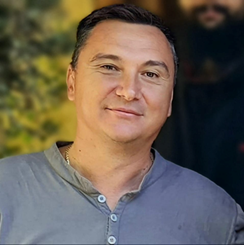
Mr. Dejan Antikj is PREX Global Network(PGN) member who participated in the course on “Training and Dialogue Program Financial and Technological Support for Small and Medium Enterprises Promotion(A)” in year 2011 which was entrusted by JICA.
Even after more than 10 years have passed, PREX staff and Mr. Dejan communicate time to time. And we come to wonder his strong motivation and passion toward his work. And also why he likes Japan so much.
So we decided to have interview session and ask about his career and history.
Starting from today, we will upload his story which divided into 4(four) parts. Every part contain his passion, motivation and positive attitude toward his life.
As a series of 【PREX Global Network Interview 】, interviews of past participants who have interesting background will be uploaded regularly.
We hope this articles will bring you some insight and more than that, hope you enjoy these article.
******************************************************************************
Vol. 4
Interview with the PREX Global Member after meeting 13 years ago
His passion to support people and love to Japanese culture
Interview with Mr. Dejan Antic
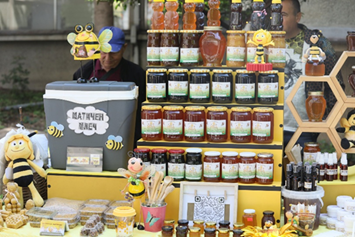
Through the activities of Honey bee Park, we would like to educate the children about importance of bee, and tradition of Macedonia about bee relating culture.
And this idea come from learning in Tokushima in Japan———————————————-
PREX:
That’s a wonderful achievement. So how do you plan to use the honeybee park once it is finished?
Dejan:
Well, the idea came from what I learned in Tokushima, Japan.
There, I was inspired by the Japanese mindset — that there is always space to do something more, to innovate further.
So, after we decided to build this honeybee park in front of the faculty building, I thought: why stop with just serving students and trainees?
Let’s expand its purpose to include the general public, school children, even kindergarten kids. The aim is to teach them about the importance of bees — how bees are crucial for our food supply, and ultimately for our very existence. It is important that we spread this awareness, starting from the youngest generation.
This honeybee park will not only train professional beekeepers but also serve as a place to communicate the deep tradition of beekeeping culture in Macedonia, and how vital bees are to our ecosystem.
Currently, the park is almost complete. Just recently, together with our project specialist , we visited the laboratory for biology and selection of honey bees to check on the final preparations.
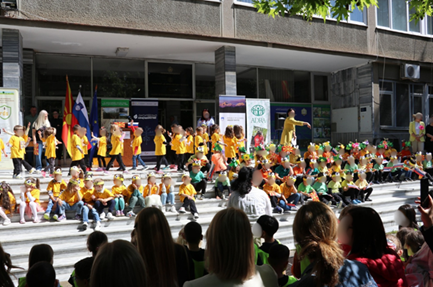
If we have Honey park, the education for bee keeping will be more practical——
PREX:
If you have the Honey Bee Park, do you think education for beekeeping will become more practical?
Dejan:
Absolutely. One problem I have noticed is that even the most innovative professors cannot implement their creative ideas, because there is no mechanism — like you have in Japan — to actually support and put those ideas into practice. While talking with professors, I was carefully listening to their challenges.
One of them explained to me, “Look, we are handicapped. I can give lectures, show theories and scientific research to 25 students in this room, but if I want to demonstrate these things practically, I have to take them 20 kilometers away to the faculty field. That costs a lot of time and money, so the students really miss out on practical knowledge.”
I asked, “Professor, do you have a creative solution for this?”
Because I knew from my training in Japan — through JICA and the Pacific Resource Exchange Center — that theoretical learning was always combined with field visits and hands-on practice.
That is very effective.
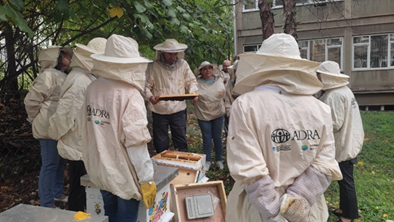
So the professor suggested, “Why don’t we break through the classroom wall, build a door with steps, and set up some real beehives right in the small yard you can see through the window? Then, after the lecture, the students can immediately walk through that door into the yard and apply what they just learned about bees.” I thought, That’s brilliant. Although this was not part of the original project plan, I promised I would discuss it with the donor, my project team, and the director. And we made it happen. Everyone was happy.
So now, in addition to the 50 trainees we regularly teach about beekeeping, we also give them a chance to immediately apply their theoretical knowledge in a practical setting right on the faculty grounds. This is part of what ADRA has left as a legacy: not only investing in people, especially those who are in need, but also investing in the educational system itself. We helped improve one of the country’s top educational institutions.
This is a peak innovation, and I must say, the inspiration for it came from the knowledge I gained in Japan.
PREX:
So you absorbed that knowledge and adapted it to the Macedonian situation — changing the way you convey knowledge, not just through lectures but also through practical experience. That’s wonderful. What was the hardest part about adjusting the Japanese knowledge into North-Macedonian way?
Dejan:
When I applied for the JICA course, I was selected through the Japanese Embassy in Belgrade. At that time, they told me,“Mr. Dejan, you have already done impressive work with USAID and other organizations. What more do you want to gain?”
My answer was that while I had learned a lot through my work and at the faculty, it wasn’t integrated — it was fragmented. I needed a specialized course to bring my knowledge to the next level. That was how I felt, and I passed the selection.
After completing the training, I gained a huge amount of knowledge — honestly, I feel now that even compared to graduates of Harvard, Yale, Carnegie Mellon, or Oxford, I can stand equally, or even higher, in terms of what I know thanks to the JICA training. That is truly how I feel.
Wherever I have the chance, I talk about my experience in Japan and about the Japanese people, because they helped me grow — both professionally and personally. And ever since I returned from Japan, I have remained in close contact with my Japanese colleagues and friends.
“Japan Has Been My North Star”———————————
PREX:
Dejan, when did your relationship with Japan begin first?
Dejan:
It actually started with books. I was about ten when I discovered Japanese history, Ninja legends, and—later in high school—economics and culture. I devoured everything I could find.
PREX:
Books are one thing, but real life is another. When did that book-world turn into something personal?
Dejan:
Summer 1987. My older sister landed a two-month traineeship in Athens through AIESEC. She insisted that I should spend the vacation with her.
The very first night, the exchange-students threw a welcome party, and my sister became friends with a Japanese student from Nagoya—By the end of the evening we were all inseparable.
PREX:
So the friendship didn’t end in Athens?
Dejan:
Not at all. When the program wrapped up, we invited Asako to our home in Skopje. She came by train, stayed with my family, and we’ve been “extended family” ever since.
She’s now Professor and Dean at famous University in Japan. and for us she’s still good friend and she did not change from that summer.
PREX:
You eventually visited Japan yourself.
Dejan:
Yes. JICA chose me for a management program in Osaka. I finally saw the Japan I’d only imagined. The people, the energy—it all clicked.
I returned to Macedonia overflowing with ideas, friendships, and a sense of purpose.
Building Bridges—Formally and Informally————————–
PREX:
Since then you seem to have become a go-to person whenever Japan meets Macedonia.
Dejan:
It just keeps happening. Over the years I’ve hosted Japanese experts sent by JICA, advised our Ministry of Economy on projects with Japan, and lectured for SME support programs.
None of it is an official post; it’s more like I’m on Japan’s “speed-dial” in Macedonia.
PREX:
And you helped create a student exchange between Hokkaido University and Euro College?
Dejan:
Exactly. For more than a decade, Hokkaido master’s students have spent two-week research trips in Macedonia. I guide them through fieldwork and local culture. Chinese students studying at Hokkaido come too. It’s my way of giving back for everything Japan has given me.
An “Official Friend of Japan”———————
PREX:
Your ties even reach the Japanese Embassy.
Dejan:
I often bring Hokkaido students there, so the diplomats know me.
Last November I finally met the important executive at a medical-charity concert. Today, in fact, I’m invited to the ambassador’s farewell reception at the Marriott. They call me an “official friend of Japan,” and I wear that badge proudly.
Looking Back—and Ahead————–
PREX:
If you had to sum up why your love for Japan endures, what would you say?
Dejan:
It’s a mix of gratitude and destiny. Books sparked the curiosity, my good friend opened the door, PREX gave me skills and confidence, and every new connection deepens the bond.
The generosity I’ve received from Japanese friends and institutions is something I’ll spend my life repaying—through projects, exchanges, or simply introducing two people who should know each other. My love for Japan is forever.
———————————————-
This is the article compiled based on the interview with Mr. Dejan. Hope this article gives readers beautiful aspect of life, and challenges.
We will post the “Interview” series of past-participants.
Look forward to the next issue!
PREX
- 2026-04-17

