

【PREX Global Network Interview Vol.5】 Mr. Dejan ANTIKJ (North Macedonia) Vol. 3/4
Passion toward his work and great fan of Japan in North Macedonia!
Mr. Dejan Antikj is PREX Global Network(PGN) member who participated in the course on “Training and Dialogue Program Financial and Technological Support for Small and Medium Enterprises Promotion(A)” in year 2011 which was entrusted by JICA.
Even after more than 10 years have passed, PREX staff and Mr. Dejan communicate time to time. And we come to wonder his strong motivation and passion toward his work. And also why he likes Japan so much.
So we decided to have interview session and ask about his career and history.
Starting from today, we will upload his story which divided into 4(four) parts. Every part contain his passion, motivation and positive attitude toward his life.
As a series of 【PREX Global Network Interview 】, interviews of past participants who have interesting background will be uploaded regularly. We hope this articles will bring you some insight and more than that, hope you enjoy these article.
******************************************************************************
Vol. 3
Interview with the PREX Global Member after meeting 13 years ago
His passion to support people and love to Japanese culture
Interview with Mr. Dejan Antic
Reality in North Macedonia———————————-
PREX:
I see, thank you. I heard there are many NGOs in Macedonia. Sometimes I wonder is it challenging to create projects that truly match local needs?
Dejan:
That’s a very good point. In Macedonia, there are indeed many NGOs and institutions that write proposals and implement projects but sometimes their proposal dose not fit the realities of the region.
PREX and the Japanese government invested a significant amount of resources in me so that I could do a proper job — to serve the actual needs of people, and to make sure as many people as possible benefit. I have felt a strong sense of responsibility ever since.
In this way, by involving educational institutions, we ensured high-level technical knowledge. As I learned in Japan, it is very important to communicate and coordinate with all levels of government.
So, in this project, I made sure we communicated with the Slovenian government, who is funding the three-year initiative, and also with Macedonia’s central Ministry of Agriculture. We put ourselves forward to work in two specific regions of Macedonia, as required by the Slovenian government.
Macedonia is divided into eight planning regions, and after some analysis, we chose the two poorest — the Northeast and Vardar regions — where we could try to find people interested in becoming beekeepers.
Drawing on what I learned from PREX and JICA in Japan, where you showed us examples of involving prefectural governments, regional offices, and local municipalities, I reached out to the local self-government offices to help spread the word.
I explained the project’s goals in person at the municipal offices so that even people in remote villages would hear that there was a good opportunity coming. Anyone interested in starting a beekeeping business could apply through ADRA Macedonia and learn about the support we could provide.
The mission was to identify 25 start-ups people who had never done beekeeping before. Then, another 25 existing beekeepers who needed advanced knowledge and support to grow their business. Finally, 25 young women. The project title is “Women Beekeepers as Drivers for Positive Change in North Macedonia.”
We went out to each municipality, explaining publicly that we were there to help people establish beekeeping businesses, and that we would provide everything they needed — beehives, bee colonies, protective uniforms, and beekeeping tools — completely free of charge.
The beauty of this project is that we also provide three years of support: education, training, supervision, monitoring, and evaluation.
We give both theoretical knowledge and practical skills through the Faculty of Agricultural Sciences, just like a formal course. Our aim is to create first-class, highly educated beekeepers, not people who just pick up improvised skills from YouTube, but truly well-trained professionals.
This approach was inspired by what I saw in Japan — for example, in Shiga Prefecture, where the manager of the Shiga Prefecture Industrial Support Center gave a wonderful presentation about how they achieved an 80% success rate in keeping young people in the region through innovative programs. That really impressed me.
In our case, from the first group of 25 start-ups, we actually recruited 30. So we achieved more than 100% of our target. These 30 people from different towns in Macedonia received all the equipment and attended training in Skopje at the Faculty of Agriculture.
Additionally, another 25 existing beekeepers got advanced training, new techniques, and support with essential equipment. In total, we were able to positively change the lives of more than 60 people through this part of the project.
This was just one of the jobs we have accomplished, along with other beekeeping projects supported by our headquarters in the USA as well.
Based on the findings in Japan, Beekeeping Project expanding————————
PREX:
That’s wonderful. I heard that now you are expanding the beekeeping project even further. Could you share more about that?
Dejan:
Yes. Right now, we are expanding the beekeeping initiative.
One of the keys to our success is the excellent cooperation we built with world-know Macedonian professor and scientist from the Faculty of Agricultural Science and Food-Skopje. 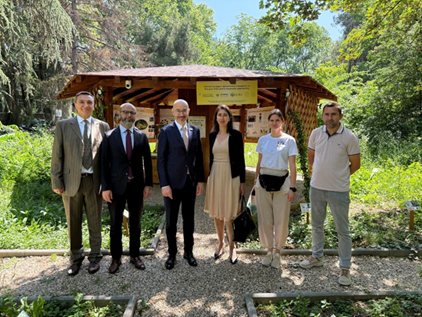
His main assistant is also part of our project team, which is one of the reasons why this project has been working so well.
Together with my team, I told them, “Look, we have world-class experts here, plus collaboration with Slovenian experts — let’s combine our efforts and innovate.”
That’s how the idea came up to establish a Honeybee Park in Macedonia.
I approached the Professor and explained, “Professor, we now have this great three-year project. I am invited to speak publicly around the country and even in Slovenia. I feel enormous gratitude for the knowledge and experiences I gained in Japan.”
I also made it clear that I am not a honeybee expert myself — and neither is my country director. But we are here to fully support the professor’s vision and ideas.
He had dreamed about creating something like this for a long time but lacked institutional support in Macedonia. Through ADRA, I told him, “Let’s work together to make something even bigger than you imagined.”
So that is what we did.
Whenever I speak publicly about this project, I always emphasize what I learned in Japan. If you truly want to carry out a development project, you must remember: development means making changes. You cannot achieve real development without change or without innovation.
In Japan, I learned that in every part of life and work, you are encouraged to think about how to improve things. I always share how grateful I am that the Slovenian government saw the need to fund a genuine development project over three years.
In Macedonia, it is unfortunately common for foreign donors — whether from the EU, the UN, or others — to fund projects that last only nine months. I have always wondered what you can realistically achieve in such a short time.
In contrast, as I learned in Shiga, Osaka, Tokushima, and everywhere PREX took us, if you want sustainable growth and real development, projects must run for three to five years with continuous support. That is the kind of mindset I try to apply here.
PREX:
That is impressive. So you actually built a honeybee park as a result of this project?
Dejan:
Yes, exactly.
One important thing I always emphasize — as I learned during my time in Japan — is that for a project to truly succeed, you need support and cooperation from various partners. That was the same with this initiative.
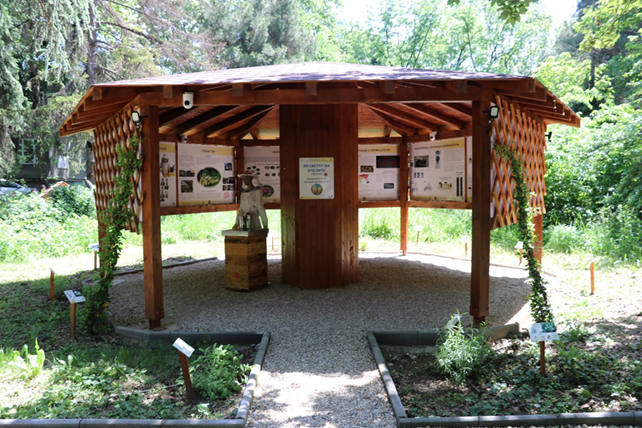
Returning to the Honeybee Park itself, we designed it to fit our local circumstances. The Faculty of Agricultural Science and Food in Skopje has a large yard area, which until now had been completely deserted.
I looked at various possibilities and similar examples from other countries. I realized that if we built a honeybee park somewhere else, there was a high risk that after the project ended, it might be neglected or even destroyed.
So I proposed: “Let’s use this unused yard in front of the student housing, and turn it into a permanent Honeybee Park.”
Everyone supported this idea — the donor, the faculty, and the world-known Macedonian Professor. Once they agreed, Professor took the lead in designing both the architectural and scientific aspects of the honeybee farm. We also received valuable support from the Slovenian honeybee experts.
Right now, the park is in its final stages of completion. I’m very excited, but to be honest, I still see more opportunities for improvement, so I am not fully satisfied yet.
(to be continued to last article)
- 2026-04-03

